Animals / Mammal
African savanna hare
Lepus victoriae · Leporidae
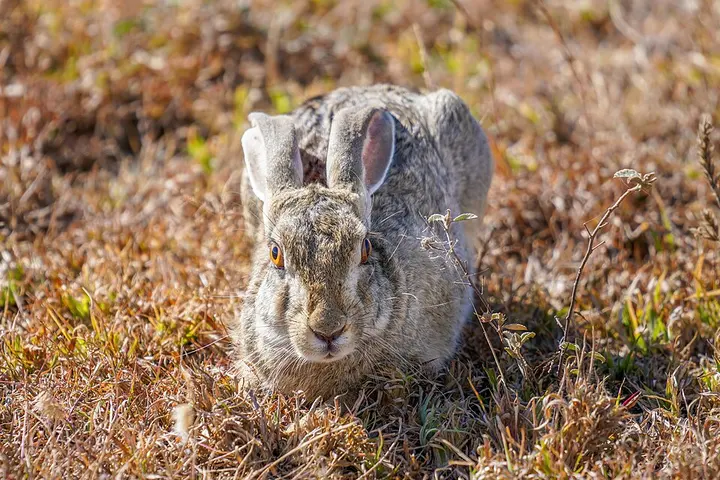
The African savanna hare is a mammal species in the family Leporidae, native to Africa. It is listed as "least concern" on the IUCN Red List.
Appearance
The African savanna hare is a medium-sized species growing to a length of between 41 and 58 cm (16 and 23 in) with a weight of between 1.5 and 3 kilograms (3.3 and 6.6 lb). The ears have black tips, the dorsal surface of head and body is greyish-brown, the flanks and limbs are reddish-brown and the underparts are white. The general colouring is richer in tone than other hares, especially in mountain regions where the hares are a rather darker shade.
Behaviour
African savanna hares are solitary, nocturnal animals. They rely on camouflage to stay hidden, but can run at up to 70 kilometres (43 mi) an hour and sometimes leap vigorously sideways to break the scent trail they are leaving. They feed mainly on grasses and herbs but also chew roots, shoots and bark and sometimes eat fallen fruit and occasionally fungi. They engage in coprophagy, eating their own dry faecal pellets so as to extract further nutrients from them.
Habitat
It is native to diverse regions and habitats of Africa, including savannas and the Sahel. It is found in Algeria, Botswana, Burundi, Chad, the Democratic Republic of the Congo, Côte d'Ivoire, Ethiopia, the Gambia, Ghana, Guinea, Guinea-Bissau, Kenya, Libya, Mali, Mauritania, Morocco, Mozambique, Namibia, Niger, Nigeria, Rwanda, Senegal, Sierra Leone, Somalia, South Africa, Sudan, Tanzania, Tunisia, Uganda, and Zambia.
Where the African savanna hare lives
Recorded in Zambia, Angola, Kenya, Botswana, Tanzania, Mozambique, South Africa and Benin (Africa).
Most records fall in Central, Bengo, Rift Valley, North-West, Arusha and Tete.
See the African savanna hare’s range on the globe
Conservation status
Least concern (LC). Not at risk: it is doing well in the wild. Categories are the IUCN Red List as republished by GBIF.
Sources
The range is a density of 1,841 georeferenced GBIF records, shown on the continents where it is mainly recorded, not an expert-drawn map. Description from Wikipedia.