Animals / Bird
African penguin
Spheniscus demersus · Spheniscidae
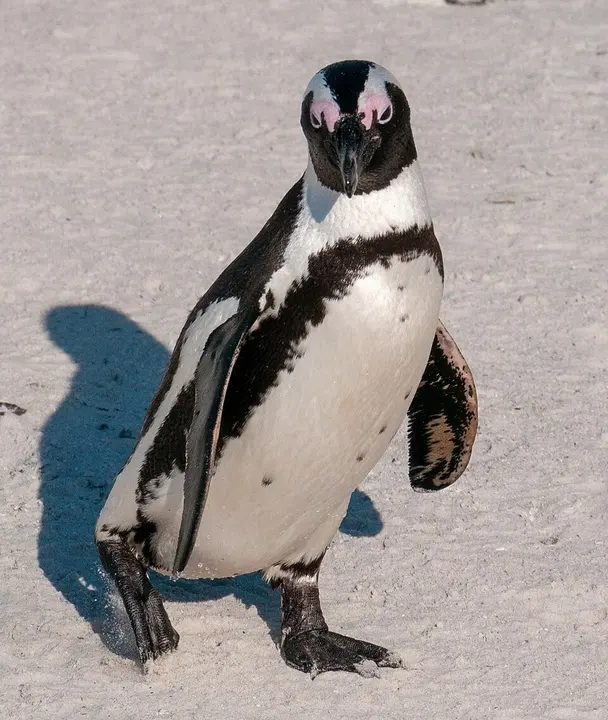
The African penguin, also known as the Cape penguin or the South African penguin, is a species of penguin confined to southern African waters. It is the only penguin found in the Old World. Like all penguins, it is flightless, with a streamlined body and wings stiffened and flattened into flippers for a marine habitat.
Adults weigh an average of 2.2–3.5 kg (4.9–7.7 lb) and are 60–70 cm (24–28 in) tall. The species has distinctive pink patches of skin above the eyes and a black facial mask. The body's upper parts are black and sharply delineated from the white underparts, which are spotted and marked with a black band. The African penguin is a pursuit diver and feeds primarily on fish and squid. Once extremely numerous, the African penguin is now the rarest species of penguin, classified as critically endangered, with its population declining rapidly due to a combination of several threats, such as habitat loss, overfishing and climate change. It is a charismatic species and is popular with tourists.
Appearance
African penguins grow to 60–70 cm (24–28 in) tall and weigh between 2.2–3.5 kg (4.9–7.7 lb). The beak length of the African penguin varies, usually growing between 4.8–6.5 cm (1.9–2.6 in). They have a black stripe and black spots on the chest, the pattern of which is unique to each penguin, like human fingerprints. The sweat glands above the eyes cool the birds' blood and as the temperature rises, increased blood flow causes the glands to get pinker.
Behaviour
African penguins forage in the open sea, where they feed on pelagic fish such as sardines (including the blue pilchard), South African mullet, Cape horse mackerels, red-eye round herrings and anchovies (specifically the European anchovy and the Southern African anchovy) and marine invertebrates such as squids (Loligo reynaudi) and small crustaceans, primarily krills, shrimps and Pterygosquilla armata. Penguins normally swim within 20 km (12 mi) of the shore.
Diet
African penguins forage in the open sea, where they feed on pelagic fish such as sardines (including the blue pilchard), South African mullet, Cape horse mackerels, red-eye round herrings and anchovies (specifically the European anchovy and the Southern African anchovy) and marine invertebrates such as squids (Loligo reynaudi) and small crustaceans, primarily krills, shrimps and Pterygosquilla armata. Penguins normally swim within 20 km (12 mi) of the shore.
Habitat
The African penguin is found on the southern and southwestern coast of Africa, living in colonies on 27 islands between Namibia and Algoa Bay, near Port Elizabeth, South Africa. It is the only penguin species that breeds in Africa, and its presence gave name to the Penguin Islands. Two colonies were established by penguins in the 1980s on the mainland near Cape Town, namely Boulders Beach near Simon's Town and Stony Point in Betty's Bay.
Where the African penguin lives
Recorded in South Africa and Namibia (Africa).
Most records fall in Western Cape, Eastern Cape, Karas, Erongo and Northern Cape.
See the African penguin’s range on the globe
Conservation status
Critically endangered (CR). In very great danger of dying out in the wild. Categories are the IUCN Red List as republished by GBIF.
Sources
The range is a density of 15,563 georeferenced GBIF records, shown on the continents where it is mainly recorded, not an expert-drawn map. Description from Wikipedia.