Animals / Mammal
African forest elephant
Loxodonta cyclotis · Elephantidae
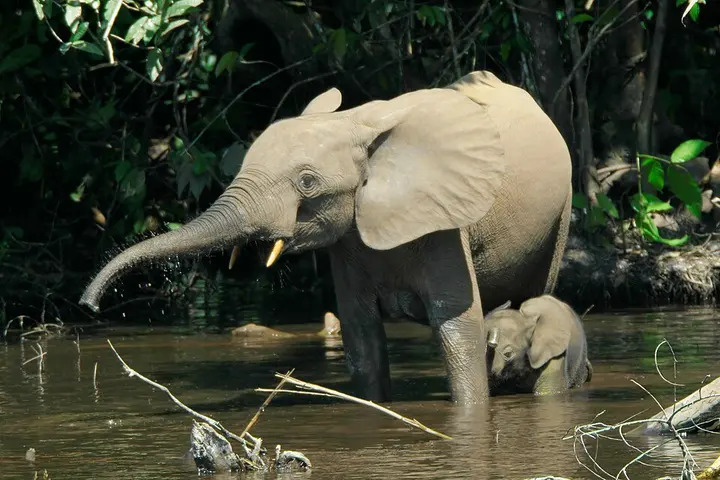
The African forest elephant is an elephant species native to humid tropical forests in West Africa and the Congo Basin. It was first described in 1900. With an average shoulder height of 2.16 m, it is the smallest of the three extant elephant species.
Both sexes have straight, down-pointing tusks, which begin to grow at the age of 1–3 years. The African forest elephant lives in highly sociable family groups of up to 20 individuals comprising adult cows, their daughters and sons. When young bulls reach sexual maturity, they separate from the family group and form loose bachelor groups for a short time, but usually stay alone. Adult bulls associate with family groups only during the mating season. The African forest elephant forages on leaves, seeds, fruit, and tree bark of at least 96 plant species. Since it disseminates partly digested seeds for at least 5 km (3.1 mi) through its droppings, it contributes significantly to maintaining the diversity and structure of the Guinean Forests of West Africa and the Congolese rainforests.
Appearance
The African forest elephant is considerably smaller than the African bush elephant, though the size of the species has been subject to contradictory estimates. A 2000 study suggested that bulls of the species reach a shoulder height of 2.4–3 m (7.9–9.8 ft), and weighed 4–7 t (4.4–7.7 short tons), while cows were about 1.8–2.4 m (5.9–7.9 ft) tall at the shoulder and 2–4 t (2.2–4.4 short tons).
Behaviour
The African forest elephant lives in family groups. Groups observed in the rain forest of Gabon's Lopé National Park between 1984 and 1991 comprised between three and eight individuals. Groups of up to 20 individuals were observed in the Dzanga-Sangha Complex of Protected Areas, comprising adult cows, their daughters and subadult sons. Family members look after calves together, called allomothering.
Diet
The African forest elephant is a herbivore. Elephants observed in Lopé National Park fed mostly tree bark and leaves, and at least 72 different fruits. To supplement their diet with minerals, they congregate at mineral-rich waterholes and mineral licks.
Habitat
Populations of the African forest elephant in Central Africa range in large contiguous rainforest tracts from Cameroon to the Democratic Republic of the Congo, with the largest stable population in Gabon, where suitable habitat covers 90% of the country. They are also distributed in the evergreen moist deciduous Upper Guinean forests in Ivory Coast and Ghana, in West Africa.
Where the African forest elephant lives
Recorded in Liberia, Gabon, Congo, Central African Rep., Ghana, Dem. Rep. Congo, Uganda and Côte d'Ivoire (Africa).
Most records fall in Sinoe, Ogooué-Maritime, Grand Cape Mount, Gbapolu, Ogooué-Ivindo and Sangha-Mbaéré.
See the African forest elephant’s range on the globe
Conservation status
Critically endangered (CR). In very great danger of dying out in the wild. Categories are the IUCN Red List as republished by GBIF.
Sources
The range is a density of 1,067 georeferenced GBIF records, shown on the continents where it is mainly recorded, not an expert-drawn map. Description from Wikipedia.