Animals / Mammal
African bush elephant
Loxodonta africana · Elephantidae
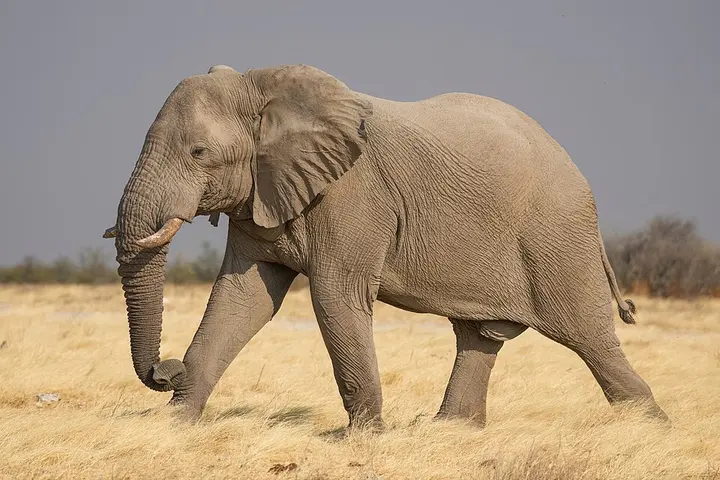
The African bush elephant, also known as the African savanna elephant, is a species of elephant native to sub-Saharan Africa and the largest living terrestrial animal, with fully grown bulls reaching an average shoulder height of 3.04–3.36 m (10.0–11.0 ft) and a body mass of 5.2–6.9 t; the largest recorded specimen had a shoulder height of 3.96 m (13.0 ft) and an estimated body mass of 10.4 t. It is characterised by its long prehensile trunk with two finger-like processes; a concave back; large ears which help reduce body heat; and sturdy tusks that are noticeably curved. Its skin is grey with scanty hairs, and bending cracks which support thermoregulation by retaining water.
The African bush elephant inhabits a variety of habitats such as forests, grasslands, woodlands, wetlands and agricultural land. It is a mixed herbivore feeding mostly on grasses, creepers, herbs, leaves, and bark. The average adult consumes about 150 kg (330 lb) of vegetation and 230 L (51 imp gal; 61 US gal) of water each day. It is a social animal that lives in herds of cows and their offspring. Adult bulls usually live alone or in small bachelor groups. During the mating season, males undergo musth, a period of high testosterone levels and heightened aggression. The menstrual cycle of cows lasts three to four months, and gestation around 22 months, the longest of any mammal. Since 2021, the African bush elephant has been listed as Endangered on the IUCN Red List.
Appearance
The African bush elephant has grey skin with scanty hairs. Its large ears cover the whole shoulder, and can grow as large as 2 m × 1.5 m (6 ft 7 in × 4 ft 11 in). Its large ears help to reduce body heat; flapping them creates air currents and exposes large blood vessels on the inner sides to increase heat loss during hot weather. The African bush elephant's ears are pointed and triangular shaped. Its occipital plane slopes forward. Its back is shaped markedly concave.
Behaviour
The core of elephant society is the family unit, which mostly comprises several adult cows, their daughters, and their prepubertal sons. Iain Douglas-Hamilton, who observed African bush elephants for 4.5 years in Lake Manyara National Park, coined the term 'kinship group' for two or more family units that have close ties. The family unit is led by a matriarch who at times also leads the kinship group.
Diet
The African bush elephant is herbivorous. It is a mixed feeder, consuming both grasses as well as woody vegetation (browse), with the proportions varying wildly depending on the habitat and time of year, ranging from almost exclusively grazing to near-total browsing. African bush elephants' consumption of woody plants, particularly their habit of uprooting trees, has the ability to alter the local environment, transforming woodlands into grasslands.
Habitat
The African bush elephant occurs in sub-Saharan Africa which includes Uganda, Kenya, Tanzania, Botswana, Zimbabwe, Namibia, Zambia, Angola, Malawi, Mali, Rwanda, Mozambique and South Africa. It moves between a variety of habitats, including subtropical and temperate forests, dry and seasonally flooded grasslands, woodlands, wetlands, and agricultural land from sea level to mountain slopes. In Mali and Namibia, it also inhabits desert and semi-desert areas.
Where the African bush elephant lives
Recorded in South Africa, Kenya, Tanzania, Botswana, Namibia, Benin, Uganda, Zimbabwe and Zambia (Africa).
Most records fall in Mpumalanga, Rift Valley, Limpopo, North-West, Eastern Cape and KwaZulu-Natal.
See the African bush elephant’s range on the globe
Conservation status
Endangered (EN). In danger of dying out in the wild. Categories are the IUCN Red List as republished by GBIF.
Sources
The range is a density of 25,781 georeferenced GBIF records, shown on the continents where it is mainly recorded, not an expert-drawn map. Description from Wikipedia.