Animals / Mammal
African buffalo
Syncerus caffer · Bovidae
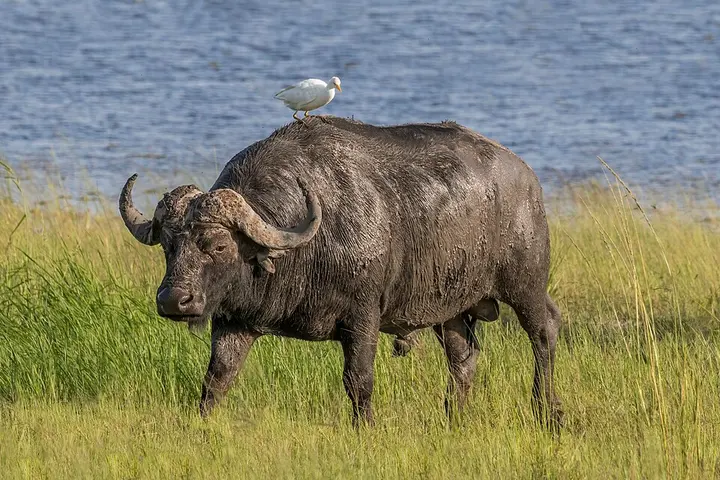
The African buffalo is a large bovid native to sub-Saharan Africa. First described in 1779 by Swedish naturalist Anders Sparrman, it is the only extant species of the genus Syncerus. Four subspecies are currently recognized: the Cape buffalo, West African savanna buffalo, Central African savanna buffalo, and African forest buffalo.
It is a heavily built animal with a broad head and torso, a strong neck, large horns, and a bony plate or "boss" between the horns of males. The fur ranges in color from rusty to black, and the tail ends with a dark, hairy tuft. The species occurs in a variety of habitats, such as woodlands, savannas, forests, grasslands, shrublands, and wetlands. It is a ruminant and a grazer, primarily feeding on grass and dietary fiber. A social animal, the African buffalo forms herds ranging in size from a few individuals to over a thousand members. Herds typically consist of adult females and their young, and a number of adult males that temporarily join herds for mating opportunities. Males have a pecking order where dominant individuals hold the best access to mates.
Appearance
The African buffalo is a large bovid characterized by its stocky build with a broad head and torso, thick, muscular neck, stubby legs, and curved hooves that grow larger in the forelegs than the hindlegs. The sagged, often scarred ears are outlined with long hairs, and the broad muzzle has a wet nose and wide eyes. The African buffalo is rusty to black in color and has a dark, hairy tuft at the end of the tail.
Behaviour
African buffalo herds are largely matriarchal, with the core comprising adult females and their young. The number of individuals in a herd is highly variable and depends on the subspecies and region. In Southern and East African floodplains, the Cape buffalo is known to form the largest herds of any subspecies, as numbers tend to exceed a thousand. In contrast, only 3–25 animals make up the average forest buffalo herd.
Diet
The African buffalo is a ruminant that primarily feeds on grass and dietary fiber. Per day, it consumes 6.5 to 15 kg (14 to 33 lb) of grass, about 2.2% of its body weight. In some cases, it is known to live off grass that most other grazers either cannot reach or chew. However, it is unable to shorten grass as much as other herbivores and instead clears the landscape for short-grass grazers, thus filling the ecological niche of an ecosystem engineer.
Habitat
Historically, the African buffalo ranged throughout most of sub-Saharan Africa in habitats with yearly rainfalls above 250 mm. Since the 19th century, geographic distribution has greatly reduced due to human factors such as poaching, climate change, agriculture, and disease outbreaks. Most savanna buffalo populations are restricted to protected areas and nearby hunting zones.
Where the African buffalo lives
Recorded in South Africa, Kenya, Benin, Tanzania, Uganda, Botswana, Zambia, Zimbabwe and Namibia (Africa).
Most records fall in Mpumalanga, Rift Valley, Limpopo, Atakora, KwaZulu-Natal and Alibori.
See the African buffalo’s range on the globe
Conservation status
Near threatened (NT). Not at risk yet, but could be soon. Categories are the IUCN Red List as republished by GBIF.
Sources
The range is a density of 17,986 georeferenced GBIF records, shown on the continents where it is mainly recorded, not an expert-drawn map. Description from Wikipedia.