Animals / Mammal
African brush-tailed porcupine
Atherurus africanus · Hystricidae
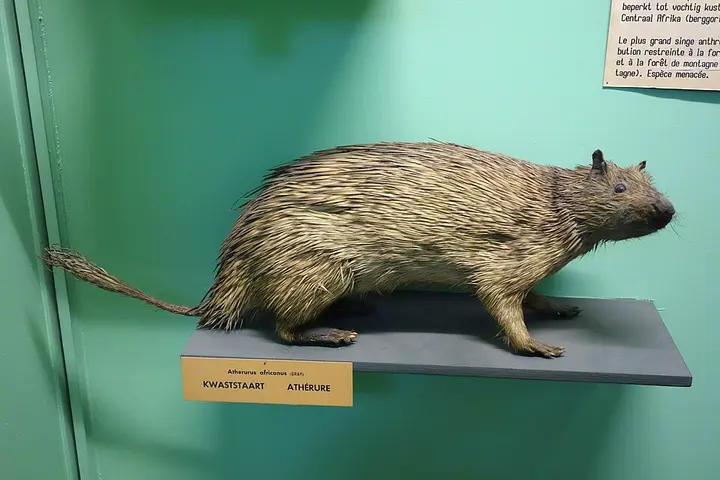
The African brush-tailed porcupine is a species of rat-like Old World porcupine, indigenous to a broad belt of Africa ranging from Guinea on the west coast to Kenya on the east. This is a common species with a very wide range, and despite it being used extensively for bushmeat, the International Union for Conservation of Nature has rated its conservation status as being of "least concern".
Appearance
The brush-tailed porcupine reaches 40 to 50 cm in length, not counting the tail. The adult weighs about 3 kg. It has an elongated, rat-like face and body and short legs, tipped with clawed and webbed feet. Unlike most other porcupines, the brush-tailed porcupine has light, small quills. On the tail, these quills are thinner and brush-like. These can make noise when rattled.
Behaviour
Brush-tailed porcupines live in small family groups of about eight members. Different family groups can share resources. When attacked by a predator (such as a leopard or a human), the porcupine raises its quills so it looks twice its size, rattles its tail quills, and stomps its feet. As with all porcupines, the brush-tailed porcupine backs into the attacker and inflicts damage with its quills.
Where the African brush-tailed porcupine lives
Recorded in Dem. Rep. Congo, Ghana, Côte d'Ivoire, Guinea, Eq. Guinea, Cameroon, Liberia, Central African Rep., Gabon, Congo and Nigeria (Africa).
Most records fall in Orientale, Eastern, Kindia, Centro Sur, Western and Mbomou.
See the African brush-tailed porcupine’s range on the globe
Conservation status
Least concern (LC). Not at risk: it is doing well in the wild. Categories are the IUCN Red List as republished by GBIF.
Sources
The range is a density of 783 georeferenced GBIF records, shown on the continents where it is mainly recorded, not an expert-drawn map. Description from Wikipedia.