Animals / Mammal
Aardvark
Orycteropus afer · Orycteropodidae
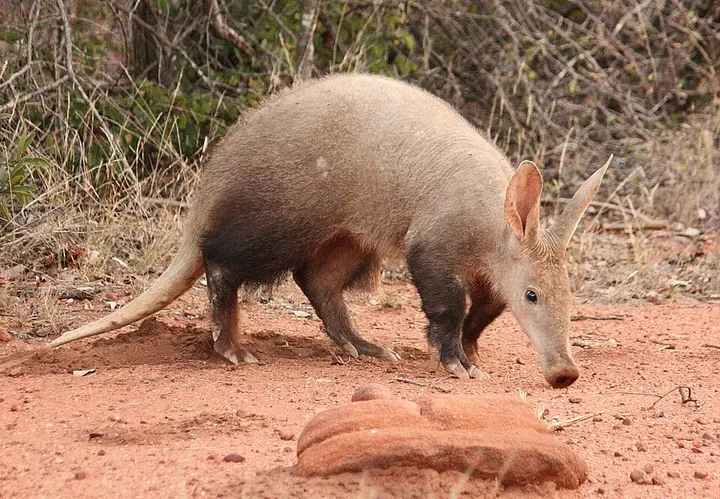
The aardvark is a medium-sized, burrowing, nocturnal mammal native to Africa. The aardvark is the only living member of the genus Orycteropus, the family Orycteropodidae and the order Tubulidentata.
The aardvark is an afrotherian, a clade that also includes elephants, manatees, and hyraxes. It is found over much of the southern two-thirds of the African continent, avoiding areas that are mainly rocky. A nocturnal feeder, the aardvark subsists on ants and termites (myrmecophagy) by using its sharp claws and powerful legs to dig the insects out of their hills, and its long snout to sniff out food. It digs a burrow in which to live and rear its young.
Appearance
The aardvark is vaguely pig-like in appearance. Its body is stout with a prominently arched back and is sparsely covered with coarse hairs. The limbs are of moderate length, with the rear legs being longer than the forelegs. The front feet have lost the pollex (or 'thumb'), resulting in four toes, while the rear feet have all five toes. Each toe bears a large, robust nail which is somewhat flattened and shovel-like, and appears to be intermediate between a claw and a hoof.
Behaviour
Aardvarks live for up to 23 years in captivity. Its keen hearing warns it of predators: lions, leopards, hyenas, and pythons. Some humans also hunt aardvarks for meat. Aardvarks can dig fast or run in zigzag fashion to elude enemies, but if all else fails, they will strike with their claws, tail and shoulders, sometimes flipping onto their backs lying motionless except to lash out with all four feet.
Diet
The aardvark is nocturnal and is a solitary creature that feeds almost exclusively on ants and termites (myrmecophagy); studies in the Nama Karoo revealed that ants, especially Anoplolepis custodiens, were the predominant prey year-round, followed by termites like Trinervitermes trinervoides.
Life cycle
It is believed to exhibit polygamous breeding behavior. During mating, the male secures himself to the female's back using his claws, which can occasionally result in noticeable scratches. Males play no role on parental care. Aardvarks pair only during the breeding season; after a gestation period of seven months, one cub weighing around 1.7–1.9 kilograms (3.7–4.2 lb) is born during May–July. When born, the young has flaccid ears and many wrinkles.
Where the Aardvark lives
Recorded in South Africa, Benin, Kenya, Namibia, Angola, Central African Rep., Zambia, Botswana and Burkina Faso (Africa).
Most records fall in Northern Cape, Western Cape, Limpopo, Atakora, Eastern Cape and Bengo.
See the Aardvark’s range on the globe
Conservation status
Least concern (LC). Not at risk: it is doing well in the wild. Categories are the IUCN Red List as republished by GBIF.
Sources
The range is a density of 1,566 georeferenced GBIF records, shown on the continents where it is mainly recorded, not an expert-drawn map. Description from Wikipedia.