Animals / Insect
17-year cicada
Magicicada septendecim · Cicadidae
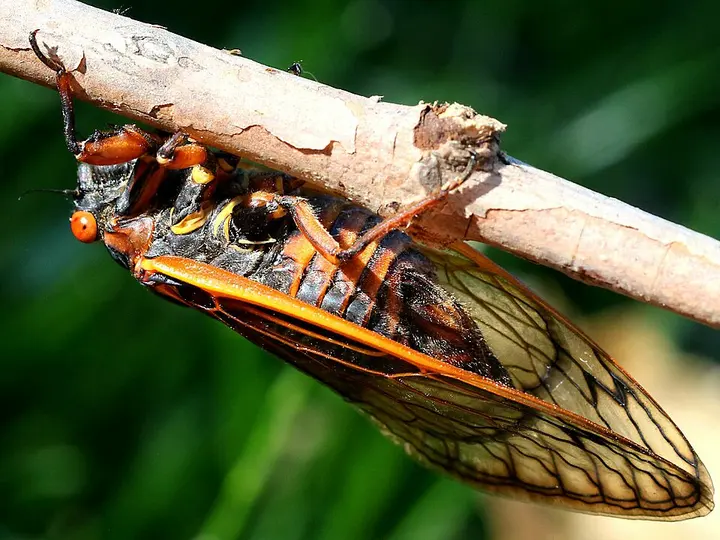
Magicicada septendecim, sometimes called the Pharaoh cicada or the 17-year locust, is native to Canada and the United States and is the largest and most northern species of periodical cicada with a 17-year lifecycle.
Appearance
Like other species included in Magicicada, the insect's eyes and wing veins are reddish and its dorsal thorax is black; it is distinguished by broad orange stripes on the underside of the abdomen and orange patches on the sides of the thorax between the eye and the forewings. Its mating call is a high-pitched song said to resemble someone calling "weeeee-whoa" or "Pharaoh", features it shares with the newly discovered 13-year species Magicicada neotredecim.
Life cycle
Their median life cycle from egg to natural adult death is around seventeen years. However, their life cycle can range between thirteen and twenty-one years.
Where the 17-year cicada lives
Recorded in United States of America (North America).
Most records fall in Maryland, Virginia, Illinois, Massachusetts, Tennessee and Pennsylvania.
See the 17-year cicada’s range on the globe
Conservation status
Near threatened (NT). Not at risk yet, but could be soon. Categories are the IUCN Red List as republished by GBIF.
Sources
The range is a density of 13,359 georeferenced GBIF records, shown on the continents where it is mainly recorded, not an expert-drawn map. Description from Wikipedia.